Mones
Sorry, this article is only in Czech.
Sorry, this article is only in Czech.


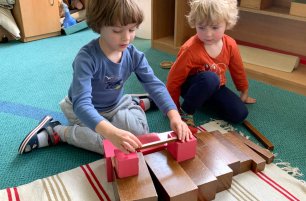
Have you ever noticed that your child enjoys singing the same song over and over again, or wants you to repeat the same story for what feels like a million times? Dr. Montessori highlighted the importance of sensitive periods in children, which are known as windows of opportunities for children to develop skills, including movement, language and most definitely, order. A child’s need for external order is present as early as childbirth and peaks in their second year, before fading at about the age of 5. This period of development helps a child to develop a connection between themselves and the world, process information and overcome challenges.
Read more
It is no surprise to hear parents expressing doubts about a multi-age classroom, and questioning how children of different ages could work together harmoniously in the same environment, and if there are any benefits to this approach.
Read more
I’m back again with more book recs! As an educator, I often turn to books to help answer difficult questions or to start a conversation about a challenging situation.
Read more
Introducing our first guest on the IMSP podcast series: Caleb Miller. After graduating from IMSP, he moved back to the United States, finishing his university degree. Caleb and our host, Mariana, chat about independence in childhood, the benefits of multi-age classrooms, and what advice he has for current IMSP Elementary students. While reflecting on his time at IMSP, Caleb looks towards the future as he pursues a career with a global focus. “That's one thing that Montessori, our school, planted in me,” Caleb tells us, “the desire to engage with the world”.
Read more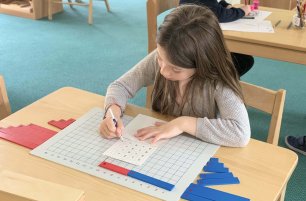
Maria Montessori often stated that not only does every human being have an innate drive to understand the environment around them, we all also naturally have what she called a “Mathematical Mind”. In the Montessori classroom, mathematical learning begins through indirect preparation long before a child is ever introduced to any Math materials.
Read more