Mones
Sorry, this article is only in Czech.
Sorry, this article is only in Czech.


It is no surprise to hear parents expressing doubts about a multi-age classroom, and questioning how children of different ages could work together harmoniously in the same environment, and if there are any benefits to this approach.
Read more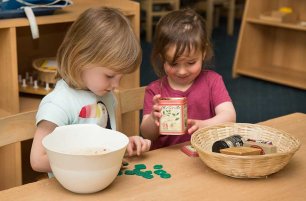
Have you ever noticed the mixed-age classrooms in a Montessori school and wondered why? This is a specific design that allows younger children to benefit from having older peers as role models and mentors and enables older children to step into leadership roles. This model mirrors real-world experiences where people of different ages work together and learn from each other.
Read more
It is often said that “the family that eats together, stays together”. We would like to suggest taking it a step further – and encourage every family to cook together, too. In Montessori, we know that kitchen work provides a host of benefits to children, all the way from toddlers to adolescents; it is a part of the Practical Life curriculum as soon as children can walk! However, its advantages are in no way tied to the classroom and can be just as easily – if not more so – applied at home.
Read more
Join us as our host, Mariana Bečková, interviews Anna Šlégrová on this week’s edition of the IMSP alumni podcast. Reflecting on what made her Montessori experience stand out, Anna stresses IMSP’s personal touch. Teachers, Mariana and Anna share, take time to get to know their students, encouraging them to pursue their passions. Now studying at the University of Bath, Anna shares how growing up in IMSP’s international environment empowered her to pursue higher education abroad.
Read more
Maria Montessori often stated that not only does every human being have an innate drive to understand the environment around them, we all also naturally have what she called a “Mathematical Mind”. In the Montessori classroom, mathematical learning begins through indirect preparation long before a child is ever introduced to any Math materials.
Read more