History of Montessori Pedagogy
"Joy, feeling one’s own value, being appreciated and loved by others,
feeling useful and capable of production are all factors of enormous value for
the human soul. "
- Maria Montessori. Childhood to Adolescence, Schocken Books, 1973.
Dr. Maria Montessori (1870-1952), the creator of what is called "The Montessori Method of Education",
based this new education on her scientific observations
of young children's behavior. As the first woman physician to graduate from the University of Rome,
Montessori became involved with education as a doctor treating children labeled as retarded. Then in 1907
she was invited to open a child-care center for the children of desperately poor families in the San Lorenzo
slums of Rome. She called it the "Casa di Bambini", and based the program on her observations that young
children learn best in a homelike setting, filled with developmentally appropriate materials that provide
experiences contributing to the growth of self-motivated, independent learners./American Montessori Society
- Dr. Montessori was nominated for the Nobel Peace Prize three times, in 1949, 1950 and 1951.
Goal of Montessori Education
- The goal of Montessori education is to foster autonomous, competent, responsible, adaptive citizens who are lifelong learners and problem solvers.
- Learning occurs in an inquisitive, cooperative and nurturing atmosphere. Students increase their own knowledge through self- and teacher-initiated experiences.
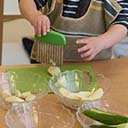
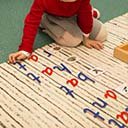
- Learning takes place through the senses. Students learn through repeated use of hands-on materials and by interacting with others. These experiences are precursors to the abstract understanding of ideas.
- The individual is considered as a whole. Physical, emotional, social, aesthetic, and cognitive needs and interests are inseparable and equally important.
- Respect for oneself, others, the environment, and life is necessary to develop a caring attitude toward all people and the planet.
What Makes Montessori Unique
- The "Whole Child" approach. The primary goal of a Montessori program is to help each child reach full potential in all areas of life. Activities promote the development of social skills, emotional growth, and physical coordination as well as cognitive preparation. The holistic curriculum, under the direction of a specially trained teacher, allows the child to experience the joy of learning, time to enjoy the process and insure the development of self-esteem, and provides the experiences from which children create their knowledge.
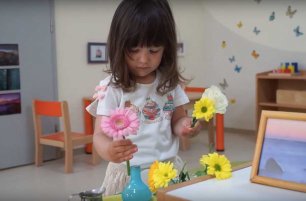
- The "Prepared Environment". In order for self-directed learning to take place, the whole learning environment (room, materials and social climate) must be supportive of the learner. The teacher provides necessary resources, including opportunities for children to function in a safe and positive climate. The teacher thus gains the children's trust, which enables them to try new things and build self-confidence.
- The "Montessori materials": Dr. Montessori's observations of the kinds of things which children enjoy and go back to repeatedly led her to design a number of multi-sensory, sequential and self-correcting materials which facilitate the learning of skills and lead to the learning of abstract ideas.
- The "Teacher", originally called a "Directress". The Montessori directress functions as designer of the environment, resource person, role model, demonstrator, record-keeper and meticulous observer of each child's behavior and growth. The directress acts as a facilitator of learning.
Traditional vs. Montessori
| Traditional | Montessori |
|---|---|
| Textbooks, pencils, worksheet | Prepared kinesthetic materials with incorporated control of error. Specially developed reference materials. |
| Working and learning without emphasis on social development. | Working and learning matched to the social development of the child. |
| Narrow, unit driven curriculums | Unified, internationally developed “curriculum” |
| Block time, period lessons | Integrated subject and learning based on developmental psychology. |
| Individual subjects | Uninterrupted work cycles |
| Single graded classroom | Multi-graded classroom |
| Students passive and quiet in desks | Students active, talking, with periods of spontaneous quiet; freedom of movement |
| Student fits mold of school | School meets the needs of Students |
| Students leave for special help | Ideally, special help comes to students |
| Product focused report cards | Process-focused assessment, skill check-list Mastery benchmarks /By Tim Duax, Ph.D. Montessori Education Researcher |
Prepared Environment
"The first aim of the prepared environment is, as far as it is possible, to
render the growing child independent of the adult."
- The Secret of Childhood: Fides Publishers, 1966: p. 267
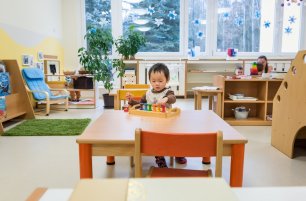
- Classrooms are referred to as Prepared Environments.
- Classrooms are child-centered.
- Materials and classrooms are structured to help develop a sense of order, concentration, coordination, and independence.
- There is an abundance of materials to meet the needs of many developmental levels.
- The materials are sequenced from simple to complex and are presented in the classroom in a logical order throughout the year.
- There is a quiet busy tone.
- A sense of community is fostered in classrooms composed of mixed-age groupings.
- There is a balance of freedom and responsibility in the classroom.
"There is only one basis for observation: the children must be able to express
themselves and thus reveal those needs and attitudes which would otherwise remain hidden
or repressed in an environment that did not permit them to act spontaneously.
An observer obviously needs something to observe, and if he must be trained
to be able to see and recognize objective truth, he must have at his disposal
children placed in such an environment that they can manifest their natural traits."
- The Discovery of the Child: The Clio Montessori Series reprinted 1994: p. 48.
The Pedagogy at Work
Each Montessori class, from toddlers through elementary school, operates on the principle of freedom within limits. Every program has its set of ground rules, which differs from age to age, but is always based on core Montessori beliefs of respect for each other and for the environment. Children are free to work at their own pace with materials they have chosen, either alone or with others. The teacher relies on his or her observations of the children to determine which new activities and materials he/she may introduce to an individual child or to a small or large group. The aim is to encourage active, self-directed learning and to strike a balance of individual mastery with small group collaboration within the whole group community. The three-year age span in each class provides a family like grouping where learning can take place naturally. More experienced children share what they have learned while reinforcing their own learning. Because this peer group learning is intrinsic to Montessori, there is often more conversational language experiences in the Montessori classroom than in conventional early education settings./American Montessori Society